7 Simple WordPress Performance Test Best Practices

WordPress Performance Test Best Practices

These days it seems most WordPress users are aware of the need for speed on their websites: conversions, SEO, user experience etc. I won’t recycle all the usual stats here ;)

Maybe you’ve read some articles and seen that you need to speed test your site. So you click on whichever tool is mentioned, input your URL and proceed to freak out at the results.

But wait! Before freaking out, make sure you’re observing these rudimentary best practices when doing a performance test on your WordPress site.


Read more

Which Speed Testing Tool Should You Use For Your WordPress Site?

Speed testing tools

Measuring the loading time of your WordPress site is obviously a critical step in optimizing for speed. You have to be able to find where the bottlenecks are and where you can achieve the easiest and biggest performance “wins”. There are numerous tools, such as Pingdom, GTmetrix etc,  available for measuring the performance of your site, each of them providing a different result, which is understandably confusing. Which one is “right” and which one should you use?

The answer depends on exactly what you want to measure and the level of detail that you want. They each provide different metrics which is why they provide different results, but it doesn’t mean that any of them is more “right” than the other.

However, no matter which tool(s) you use, what’s more important is understanding what information you’re actually getting, and being consistent with the tool you use. It’s not useful to compare results between tools – for example, between GTmetrix and Pingdom. It doesn’t matter if Pingdom says 2 seconds and GTmetrix says 5 seconds. You should only compare multiple results from the same tool, before and after you’ve made some changes.

Read more

Show Custom Text on a Password Protected WordPress Page/Post

how to show custom text on a password protected page

It’s easy to password protect an entire page or post in WordPress. But what if you would like to show part of the content on the page?

I did look for a plugin solution for this at first. I thought it would be easy to find a plugin that gave you a shortcode to wrap around content you wanted to keep protected. I was wrong (unless you want to utilize user roles, but I didn’t want people to have to log in). I came across Content Protector, but found it really unreliable.

But there’s a pretty easy solution if you’re OK with a little code. For this solution you will need:

  • A child theme (because we’re going to be editing template files)
  • An understanding of the WordPress template hierarchy
  • The confidence to edit some PHP code

If this all sounds a bit much for you, you may want to check out my post on Going Beyond WordPress Basics, to build your confidence.

Read more

Getting Started With MemberPress

Getting Started with MemberPress - a membership plugin for WordPress

There are many ways to password-protect content in WordPress. Basic password-protection is built-in and there are other free plugins to expand upon that. But if you want to generate revenue from protected content, you’ll need a fully-featured membership plugin. There are many to choose from and I can’t say I’ve tried them all, but of the ones I have tried, I really like MemberPress. It has a lot of features and capabilities, but it’s also pretty easy to get up and running with. That said, learning a new system will always present some hurdles. Here are a few basic concepts I needed to get my head around to get going with MemberPress. Hopefully this will be helpful for you, too.

Read more

Troubleshooting WordPress Issues

Troubleshooting WordPress Problems

When something goes wrong on your WordPress site, how do you react? Do you freak out, or have a mini panic attack?

Don’t worry, that’s a fairly typical reaction from the normal WordPress user 😃

With this post I’d like to change the way you look at and react to WordPress problems.

With WordPress, as with many things in life, we learn a lot when things aren’t going smoothly; learning to deal with technical problems pushes us out of our comfort zone and forces us to develop new skills and a deeper understanding.

Much of what I’ve learned in WordPress over the years has happened through things going wrong and me having to figure out how to fix it. Every time you face a problem and learn how to deal with it, your confidence is boosted and your problem-solving toolkit, and resilience, expands. The next time an issue crops up you are better equipped to handle it and you feel less panic.

Read more

How To Deal With Google Analytics Spam Data

How To Deal With Google Analytics Spam Data

There are 2 primary kinds of spam data you’ve probably seen show up in your Google Analytics reports. In some cases you may not have even realized it was spam:

1. Spam sites in your referral reports

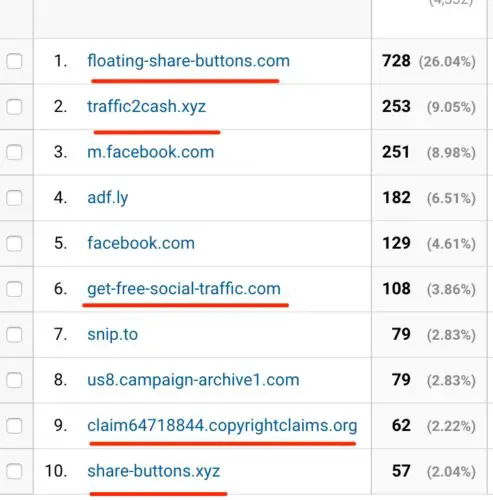
It looks like this:

Google Analytics Spam Referral Data
These are just a few of the hundreds of spam URLs you might see show up – share-buttons.xyz (actually, lots of sites with the .xyz extension), free-social-buttons, free-floating-buttons.com, copyrightclaims.org are some other common ones, but there are soooo many! Those kinds of sites look pretty dodgy from the outset and might ring some alarm bells.

Read more